Introduction
Often when people discuss duration they think of interest rate duration. However, credit duration is equally important and is frequently overlooked or less understood. It is something that sophisticated investors, such as fund managers, will watch closely and manage to a specific range.
What is Duration
Duration in a broad sense is a measure of how long it takes for an investor to have their bond investment repaid through its coupon and principal payments. It is expressed in terms of years and will typically be shorter than the tenor of the bond. It incorporates all cash flows, the coupons and the principal. Duration will be impacted by the tenor of the bond, but also the coupon rate and if it amortises (repays principal) throughout the life of the bond. A lower coupon rate will generally result in a higher duration as the final payment accounts for a more significant portion of a bond’s cashflows.
Credit Duration vs Interest Rate Duration
Whilst both credit duration and interest rate duration are measures of a bond’s price sensitivity, they refer to sensitivity of the bond to different factors. Interest rate duration is a measure of a bond’s sensitivity to movements in interest rates and credit duration is a measure of a bonds sensitivity to movements in credit spreads. The greater the credit duration, the more sensitive the bond’s capital price is to movements in credit spreads. Credit spreads are the excess return that a corporate bond receives over government bonds and are discussed in our previous Wire article that can be read here.
The easiest way to explain the differences between these two metrics is to consider a fixed and floating rate bond from the same issuer and with the same tenor. The floating rate coupon greatly reduces duration to roughly three months as the coupon rate is reset every quarter. In contrast, these two bonds will have very similar levels of credit duration as they will both be exposed to movements in credit spreads and the only small differences will be due to the size of their coupon cashflows.
Why is it Important to Take Note of Credit Duration?
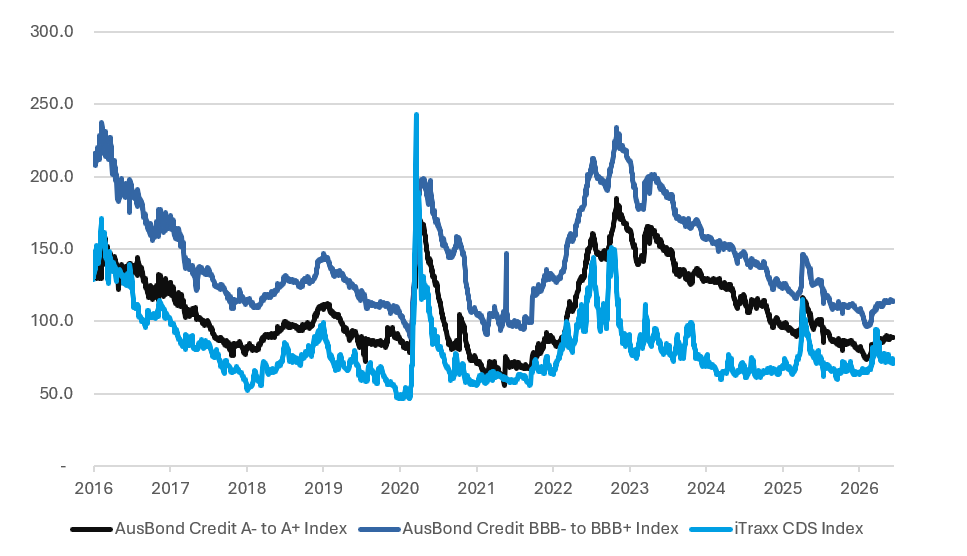
There are many factors to consider in portfolio construction, specifically how exposed the portfolio is to movements in economic conditions. Credit spreads are currently tight compared to historical averages and so the risk is that these may widen over the next few years. Recent events have seen credit spreads move wider from their recent tights, however they still remain on the lower side of their historical trading range. There are currently a number of factors that could lead to widening in spreads including geopolitical risks, high inflation and the current RBA hiking cycle. Managing this metric is important as an investor with a long credit duration would have a greater exposure to any widening in the credit spreads.
Figure 1: Credit spreads over the past 10 years
Source: Bloomberg, FIIG
If credit spreads were to widen due to a weakening economic position that required the RBA to cut rates, then yields would also likely move lower, which would cancel out some of the impact. This is one of the arguments for buying fixed rate bonds at these levels. High coupon bonds will also have a shorter duration than low coupon bonds of the same tenor. Selling low coupon bonds to buy higher coupon bonds is a way to bring cashflows forward and reduce credit duration.
Conclusion
The key to successful portfolio construction is diversification and managing metrics within certain thresholds. Just as an investor would manage their interest duration, they should consider credit duration. An investor with a 10-year fixed rate and 10-year floating rate bond may think that they have diversified duration, but these two bonds will have very similar credit duration. Instead, they should have a portfolio that is diversified across tenor and credit spread and will benefit from avoiding bonds with lower coupons.